
Jennings County Court Records After Arrest
A Jennings County jail arrest normally creates two related records. The jail side begins with intake at the Jennings County Jail. Staff record identity data, booking date, arrest date, arresting agency, holds, and release status when those fields are available in the jail portal. The court side begins after law enforcement sends reports and probable-cause material to the prosecutor. The prosecutor decides what criminal charges to file, and those filed charges become part of the Jennings County court record.
That difference matters. A booking charge is an arrest allegation, not the final court charge. The filed complaint or information can add, amend, reduce, or drop charges after review. Custody and booking details belong with Jennings County jail inmate records, while booking photos and the mugshot field belong with Jennings County jail mugshots. Court records after a jail arrest should be checked in MyCase for the case number, hearing history, charge status, bond orders, warrants, and disposition.
Find Jennings County Court Records
The official online court channel is Indiana MyCase, also available through the public court app at public.courts.in.gov/mycase. The Indiana Judicial Branch says MyCase can be used to search public, non-confidential case information and many documents at no charge. Some documents are not online, and older case availability can be limited. The Jennings County Court page directs users to local court contacts for jury duty, court dates, or document copies that do not appear online.
The MyCase help page is a useful source before reading a criminal docket because it explains the difference between public case information and documents that are unavailable online. A person booked into the Jennings County Jail may not have a searchable court case at the same moment the jail record appears. Court records after an arrest depend on filing. If the prosecutor has not filed yet, the roster and jail phone line may be ahead of the court portal.
The MyCase entry page is shown in the official MyCase search screenshot from the Indiana court portal.
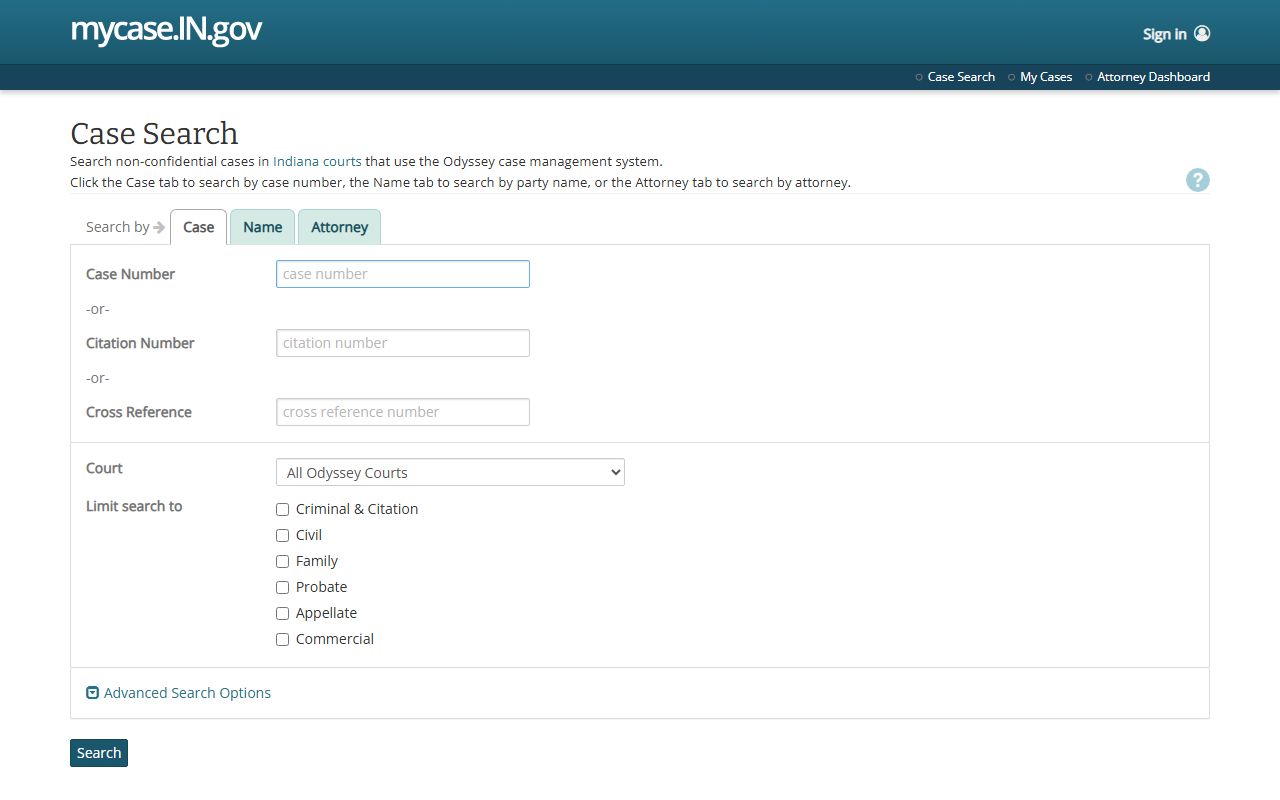
Use the portal for the court case, then confirm custody or release with the jail when the question is whether the person is still held.
| Field Label | Type | Required | Notes |
|---|---|---|---|
| Case Number | Text | Optional | Best when known. Indiana case numbers often include county, court, case type, year, and sequence. |
| Name | Text | Optional | Search by defendant or party name. Add a first name to narrow common last names. |
| Business, Attorney, Citation | Search mode or advanced field | Optional | MyCase exposes several search paths depending on the selected view. |
| Court or County | Dropdown or filter | Optional | Select Jennings County to narrow local criminal cases after a Jennings County arrest. |
| Date Filters | Date or range filter | Optional | Useful when searching recent hearings, filings, or arrests with a known time frame. |
| Search | Button | Yes after criteria | Runs the public case search after at least one workable criterion is entered. |
Jennings County Arrest to Court Path
The path is arrest, booking, prosecutor review, formal filing, initial hearing, then later hearings or disposition. Booking occurs at the jail after an arrest by the sheriff's office, North Vernon Police, Indiana State Police, conservation officers, or another authorized agency. Court records after a jail arrest begin to take shape when the prosecutor files the charging document in court. The initial hearing or arraignment is where rights, charge notice, counsel, bond, and the next court dates are addressed.
- Search the jail roster or call the Jennings County Jail to confirm booking, custody status, and any hold.
- Search MyCase by name or case number to see whether a public criminal case has been filed.
- Open the case and read the filed charges, case events, bond entries, and next hearing dates.
- Contact the court or clerk if a copy is not available online, since some documents are offline or limited.
Jennings County is in Judicial District 21 with Bartholomew, Brown, Decatur, Jackson, and Jennings counties. MyCase is statewide, so county filters matter when a name is common. Indiana State Police limited criminal history is a separate channel. It may require fees, and it is not a substitute for reading the public court case in MyCase.
Jennings County Charging Documents
Police and jail staff do not make the final charging call in a state criminal case. The Jennings County prosecutor reviews the police report and probable-cause material, then files the formal criminal charge when the case is pursued. The filing may be a complaint, an information, or, in rarer cases, an indictment. Court records after arrest should be read from that filed document forward, not just from a roster charge.
| Document | Who Files It | What It Does | Record Use |
|---|---|---|---|
| Complaint | Often initiated through law enforcement and prosecutor review | States the alleged offense and starts many criminal matters. | Useful for first-filed charge language and probable-cause context when public. |
| Information | Prosecutor | Formal charge used in many Indiana misdemeanor and felony cases. | Often the clearest source for prosecutor-filed charges after booking. |
| Indictment | Grand jury | Formal grand-jury accusation in limited cases. | Less common, but it can be the charging document that opens or advances a case. |
The Jennings County prosecutor source page is the official local contact source. The Indiana Prosecuting Attorneys Council prosecutor page lists Brian J. Belding as Jennings County Prosecutor, with the office at 200 E. Brown Street, P.O. Box 392, Vernon, Indiana 47282, phone 812-352-3041.
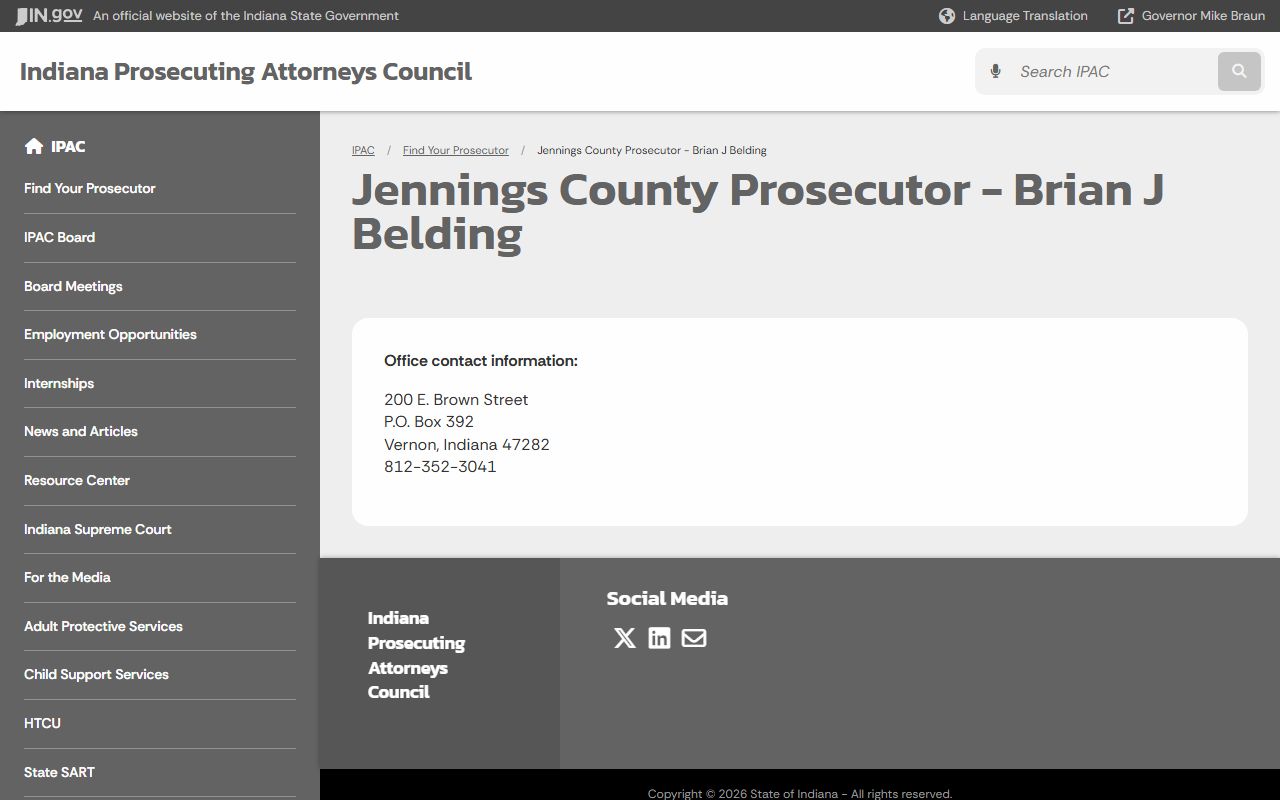
That office files state charges, but the court or clerk is the better route for public copies of filed court records.
Jennings County Charge Status
Charge status can change several times after a Jennings County arrest. A charge can remain pending, be amended, be reduced as part of plea talks, be dismissed, or result in conviction after a plea or trial. The word pending means the charge has not reached a final court outcome. A dismissed charge is not the same as an acquittal, and a filed charge is not the same as proof. Court records after a jail arrest must be read with the latest docket entry and disposition in mind.
| Status | Plain Meaning | Why It Matters |
|---|---|---|
| Pending | The case or charge is still open. | Bond, hearings, warrants, and plea deadlines may still change. |
| Amended | The prosecutor changed the charge wording, level, or count. | The first booking charge may no longer match the active court charge. |
| Reduced | The charge level or offense was lowered. | This often affects penalty range, plea terms, and record interpretation. |
| Dismissed | The court ended that charge without a conviction. | Other counts can remain active unless the whole case is dismissed. |
| Convicted | A plea or trial produced a judgment of guilt. | Sentencing, probation, jail, or DOC transfer may follow. |
Bond Warrants and Holds
Bond is set through the court process, while the jail administers release only after all court and hold conditions are met. No official Jennings County jail bond counter schedule or payment-method page was located. The safest local path is to confirm custody and bond with the Jennings County Jail at 812-346-8642, check MyCase for a bond order, ask about holds, and confirm accepted payment types before travel.
| Pathway | What It Means | Where to Confirm |
|---|---|---|
| Cash bond | Money is posted directly under court or jail rules to secure appearance. | Jail, court, or clerk before payment. |
| Surety bond | A licensed bail agent posts bond for a fee. | Bond order in MyCase and local jail release rules. |
| Own recognizance | The court orders release based on a promise to appear. | MyCase docket and jail release staff. |
| No-bond hold | Money will not release the person because of a warrant, hold, detainer, or court order. | Jail first, then the court or holding agency. |
Jennings County research did not locate an official online active-warrant list. The county Probation FAQ gives a direct instruction for warrant checks: go to the Sheriff's Department with picture ID. MyCase can also show failure-to-appear events, warrant entries, probation violation filings, and hearings in public cases. A warrant from another county, probation matter, federal agency, or immigration authority can block release even after a local bond is satisfied.
Charges Convictions and Record Limits
One of the most common mistakes is treating a Jennings County arrest or filed charge as a conviction. A charge is an accusation filed in court. A conviction is a final result after a guilty plea, guilty verdict, or other judgment of guilt. Court records after arrest should be read by stage and status, especially when a case has multiple counts.
| Point | Charge | Conviction |
|---|---|---|
| Stage | Accusation after arrest and filing. | Final judgment after plea or trial. |
| Proof Level | Based on probable cause and prosecutor filing. | Based on proof beyond a reasonable doubt or a guilty plea. |
| Record Meaning | Shows what was alleged and pursued. | Shows the court outcome and sentencing basis. |
Indiana's IC 35-38-9 provides procedures for eligible sealing or expungement of arrest and conviction records. Court access is also governed by the Indiana Rules on Access to Court Records, including Rule 4 on general access and Rule 5 on records excluded from public access.
| Point | Sealed | Expunged |
|---|---|---|
| Public Visibility | Hidden from ordinary public view when an order applies. | Access is limited under Indiana's expungement framework for eligible records. |
| Who Decides | Court order or access rule. | Court order under the expungement statute. |
| Effect on Online Records | Public search results may be limited or removed. | Official systems follow the order, but private copies may be harder to address. |
Jennings County Court Access Rules
Indiana public access has two main tracks for this topic. Jail and sheriff records are governed by Indiana's Access to Public Records Act, including IC 5-14-3. That law generally allows inspection and copying of public agency records unless an exemption applies. Law-enforcement daily-log and arrest information duties are addressed in IC 5-14-3-5. Court records use court access rules, which can limit juvenile matters, confidential filings, sealed records, certain victim information, and records excluded by rule or order.
When online records do not answer the question, use the source that owns the record. The sheriff is the route for booking logs and custody questions. MyCase and the local court are the route for public case details and copies not posted online. The prosecutor is the charging office, not a general court-copy desk. Indiana SAVIN can help with custody and release notifications, but it does not replace MyCase for the filed court record.